What is AEM Sites Optimizer?
AI Summary
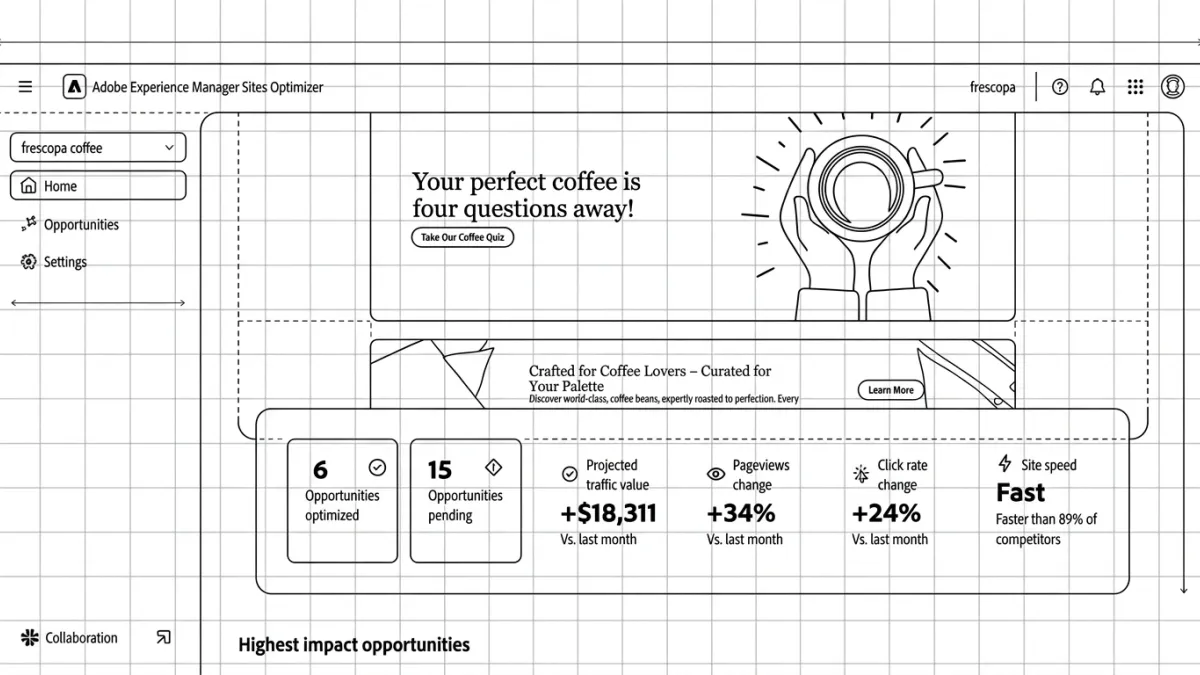
This post introduces AEM Sites Optimizer, an autonomous system that identifies and implements optimizations using AI. It is built on three pillars: auto-detection, auto-suggestion, and auto-implementation. Quentin explains how the tool automates marketing and performance tasks, allowing teams to focus on global strategy instead of technical maintenance.

Table of Contents
Cet article est aussi disponible en français : Qu'est-ce qu'AEM Sites Optimizer ?
As an SEO/GEO specialist, I’ve always dreamed of a perfectly optimized site so I could focus entirely on strategy. In reality, we all know the drill: endless manual tweaking, internal meetings to prioritize developer tickets, and roadmaps that shift throughout the year. Most of the time, we settle for a “good enough” system.
Since joining Adobe, I’ve spent my days bridging that gap through autonomous optimizations (with a human in the loop). I contribute to building AEM Sites Optimizer, a system that essentially optimizes your site by itself. From the inside, I can tell you: this is the future, and I’m having a lot of fun building it with an incredible team.
Core Values: The Three Pillars
AEM Sites Optimizer isn’t just another audit tool; it’s designed to act as a proactive member of your team. It uses AI workflows to improve your site’s performance via three pillars:
- Auto-Identify: Real-time detection of high-impact opportunities that usually go unnoticed.
- Auto-Suggest: Proposing specific fixes tailored to your site’s unique architecture.
- Auto-Implement: A way to apply the suggestions directly, often in just one click.
Preflight: Prevention Before the Cure
Even with an autonomous system, it’s better to catch errors before they ever go live. This is where Preflight acts as a proactive safety net to prevent mistakes before publication. It’s a copilot that helps you polish details often missed during the content creation phase.
- Test Before You Publish: Run diagnostic audits on draft pages right in the authoring environment.
- Target the Essentials: Catch human errors like missing H1 tags, broken links, and metadata gaps while you are still in the flow of editing.
- Zero Friction: It lives exactly where you work (Universal Editor or Sidekick), making optimization a natural part of the creative process.
A Website That Optimizes Itself
Most tools on the market stop at the “audit” phase. The best of them give you a list of recommendations. But the real magic isn’t just in discovery: it’s the ability to implement the optimization easily on the site that makes the difference.
This is where the AEM ecosystem thrives. Instead of waiting for an annual roadmap to fix sitemaps or Core Web Vitals, AEM Sites Optimizer continuously aligns your site with current best practices.
This allows marketing teams to focus on storytelling and strategy, while the technical foundation remains rock-solid. It’s a win-win: marketing gets performance, and engineers can focus on building complex new functionalities.
The Domain Experts Team
Bridging Business and Engineering
I’m part of the domain experts team. Our role is to connect engineering with the real-world needs of marketers. Our team is a melting pot of specialists, including SEO/GEO experts, SEM professionals, and performance marketers.
Refining the Logic
We focus primarily on the core logic behind AEM Sites Optimizer and Adobe Brand Visibility (formerly LLM Optimizer). We work to ensure that the “opportunities” delivered by these tools provide real strategic value rather than just technical noise.
Supporting the Platform
Beyond these specific tools, we step in to provide support when engineers need guidance on various AEM features. The goal is simple: ensure the platform remains high-performing and aligned with the evolving best practices of the industry.
AEM Sites Optimizer Opportunities
In the AEM Sites Optimizer agentic system, we don’t just talk about “fixes” or “issues.” Every optimization identified by the AI is called an opportunity. This framing represents a specific chance to reclaim traffic, boost speed, or improve the user experience autonomously.
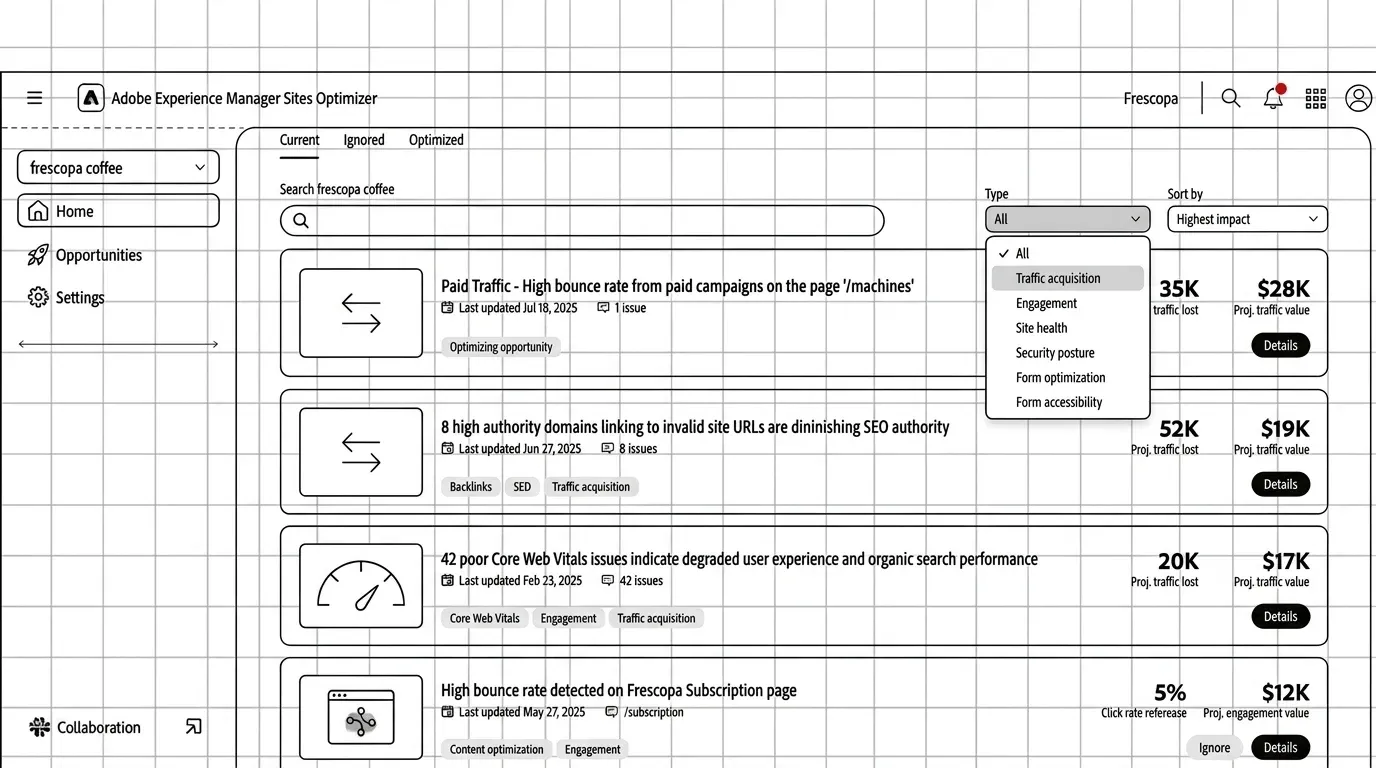
Traffic Acquisition
This is the first layer of your digital presence. The tool proposes an array of traffic acquisition opportunities designed to maximize visibility.
| Opportunity | Why it Matters |
|---|---|
| Metadata Optimization | Ensures title tags and descriptions follow best practices for clicks (CTR). |
| Structured Data | Audits JSON-LD to ensure your content is eligible for rich snippets in search results. |
| Backlink Recovery | Targets 404 pages with high-value backlinks and suggests 301 redirects to reclaim link equity. |
| Sitemap Health | Highlights errors to ensure your entire site architecture is reachable and crawlable. |
Core Web Vitals
Core Web Vitals are notoriously tricky. They are critical for performance, but rarely “easy” to fix. AEM Sites Optimizer improves Core Web Vitals by targeting metrics like LCP or CLS automatically, keeping the site fast without constant developer intervention.
Engagement & Conversion
To help you keep users moving through the funnel, the tool identifies friction points related to engagement and form optimization.
- High Bounce Rates: Identifies pages with high traffic but low dwell time, suggesting layout adjustments or better headlines.
- Broken Internal Links: Hunting down the “dead ends” that frustrate your customers (and crawlers) during their journey.
- Form Performance: Monitors abandonment and suggests ways to streamline data capture.
Accessibility & Security
Inclusion drives performance, and security is non-negotiable. We protect your brand by identifying accessibility issues and monitoring your security posture.
- Accessibility: Flagging missing alt Text and running broad scans for WCAG compliance.
- Vulnerabilities: Proactive detection of risks like XSS (Cross-site Scripting).
- Governance: Continuous audits of configurations to prevent unauthorized data exposure.
It Takes a Village (of Engineers)
Turning Ideas into Reality
While I spend my time running experiments to improve opportunities or create new ones, none of this would be possible without the brilliant colleagues at Adobe who actually build these tools or enable the domain experts to build some of them.
I am thankful for the onboarding support my colleagues have provided. In just four months, I’ve learned so much about what it takes to scale AI-driven performance at this level.
Empowering Domain Experts
What’s also exciting is how my role as a domain expert is shifting. With tools like Cursor, Claude Code, and Codex, I can innovate faster than ever. I can move from “I have an idea” to “I have a working prototype” in record time, allowing me to contribute directly to the tools we believe in.
What are you dreaming of automating?
I’m convinced that the AEM Sites Optimizer team can find a way to automate almost any repetitive hurdle we face. If you’re an SEO, an SEM, or a marketer with a “dream automation” that would change your day-to-day, I’d love to hear it. Let’s connect on LinkedIn.
Please note: All opinions and blog posts shared on this website are strictly my own personal projects. They do not represent the views, strategies, or official products of my employer, Adobe.

Hi, I'm Quentin, an SEO/GEO Specialist at Adobe building AI powered tools for Site Optimizer and Brand Visibility. I use this site to document my thoughts on where search is heading in the age of AI, and to share the strategies and shortcuts I rely on.
Connect on LinkedInRelated Articles
ChatGPT Query Fan-Out Bookmarklet v2 (GPT-5.6)
A free bookmarklet that records ChatGPT's hidden fan-out queries live, now that GPT-5.6 no longer saves them in the conversation.
ChatGPT 5.3/5.4 Query Fan Out Extraction Bookmarklet
Get a free bookmarklet to extract the hidden search queries and citations ChatGPT uses to build its answers.
My SEO/GEO Technical Stack: Architecture and Results
Go behind the scenes of an SEO/GEO-first blog architecture. Discover how Astro, Cursor, and Cloudflare deliver perfect Core Web Vitals and peak crawlability for LLMs

Hello World: My First Website
Welcome to my personal blog. Discover why I built this sandbox to document my experiments in SEO, GEO, and AI-driven search. Here's what to expect.