SEO, GEO & AI News: April 13th – April 26th, 2026
AI Summary
This post summarizes key industry shifts from April 13th to April 26th, 2026, focused on the rapid transition toward the agentic web. Quentin Yacoub breaks down OpenAI’s massive crawl volume increase, Gemini’s surging market share, and new agent-driven commerce standards—offering actionable takeaways for maintaining SEO and GEO visibility.

Table of Contents
Cet article est aussi disponible en français : Actualités SEO, GEO & IA : 13 avril – 26 avril 2026
The AI arms race is absolutely raging right now. With OpenAI launching ChatGPT 5.5, Anthropic dropping Claude Opus 4.7, and the tantalizing teases of their supposedly “too powerful” Mythos model, the pace of innovation is staggering.
This relentless momentum is directly spilling over into search and digital commerce. As you will see in this edition, the biggest underlying theme right now is the undeniable shift toward the agentic web. Between OpenAI aggressively tripling its web crawl volume, Gemini capturing a quarter of all generative AI traffic, and tech giants standardizing shopping powered by AI agents, the infrastructure of the web, and how we optimize for it, is evolving by the minute.
Dive in to see what this means for your SEO and GEO strategies, and jump straight to the sections that impact your daily work the most.
Have feedback on this digest? Connect with me on LinkedIn.
SEO News
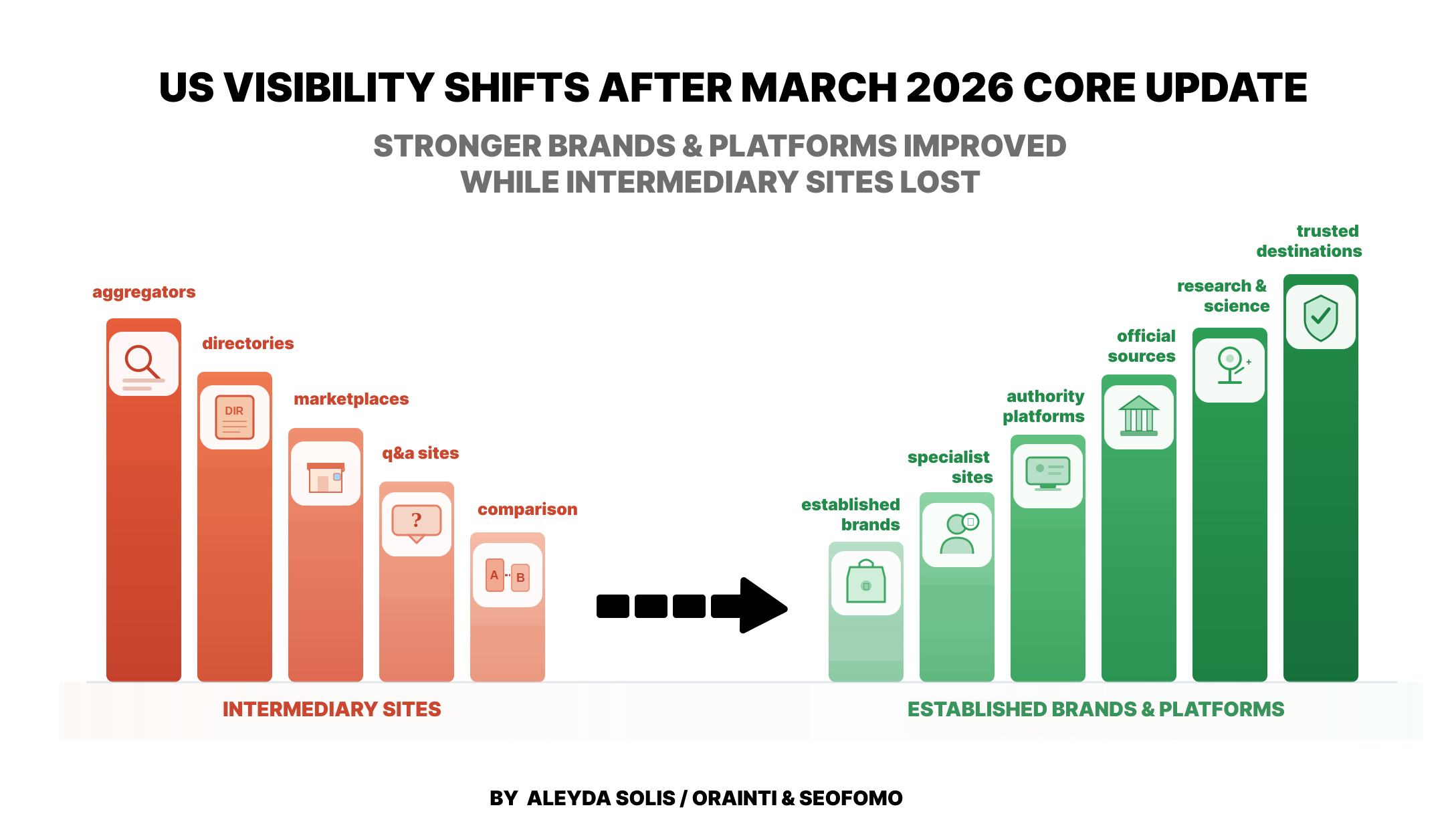
Major US Visibility Shifts After Google’s March 2026 Core Update
Aleyda Solis conducted a study on the largest US domains using Sistrix data to identify winners and losers following the March 2026 core update. The analysis reveals a massive consolidation of visibility around authoritative 'destination brands' and official sources at the expense of broad aggregators and directory-style intermediaries. This shift suggests that Google is increasingly prioritizing entities that offer direct authority and a clear, trusted fit for specific search intents.
Why it matters: I believe SEO and GEO strategies should lean more toward trust-building across high-authority directories like Trustpilot, G2, Clutch, and Reddit while ensuring the sentiment remains positive.
Manual Actions due to DNS Vulnerabilities
GSQi (Glenn Gabe)April 14, 2026This case study examines a website that experienced sudden deindexation from Google search results prior to receiving a delayed manual action notification. The investigation revealed a forgotten DNS entry on an unmonitored subdomain that allowed hackers to redirect traffic to a gambling site. It highlights the critical importance of monitoring all domain property versions in Google Search Console to detect and resolve hidden security vulnerabilities.
Read the case study
GEO News

Study on The Fan-Out Effect
AirOps' fan-out study of 353K pages identifies retrieval rank (traditional organic ranking) as the dominant visibility signal, with the top search result being 4x more likely to be cited than position 10. The data also quantifies a 6.5% citation boost from JSON-LD (specifically FAQPage and MedicalWebPage) and highlights a 30-to-89-day freshness window as the optimal period for AI retrieval.
Why it matters: While studies like Writesonic’s suggest LLMs don’t ingest JSON-LD directly, it remains essential because search engines use it to rank content, and securing a top organic position is the most impactful driver of AI visibility today.
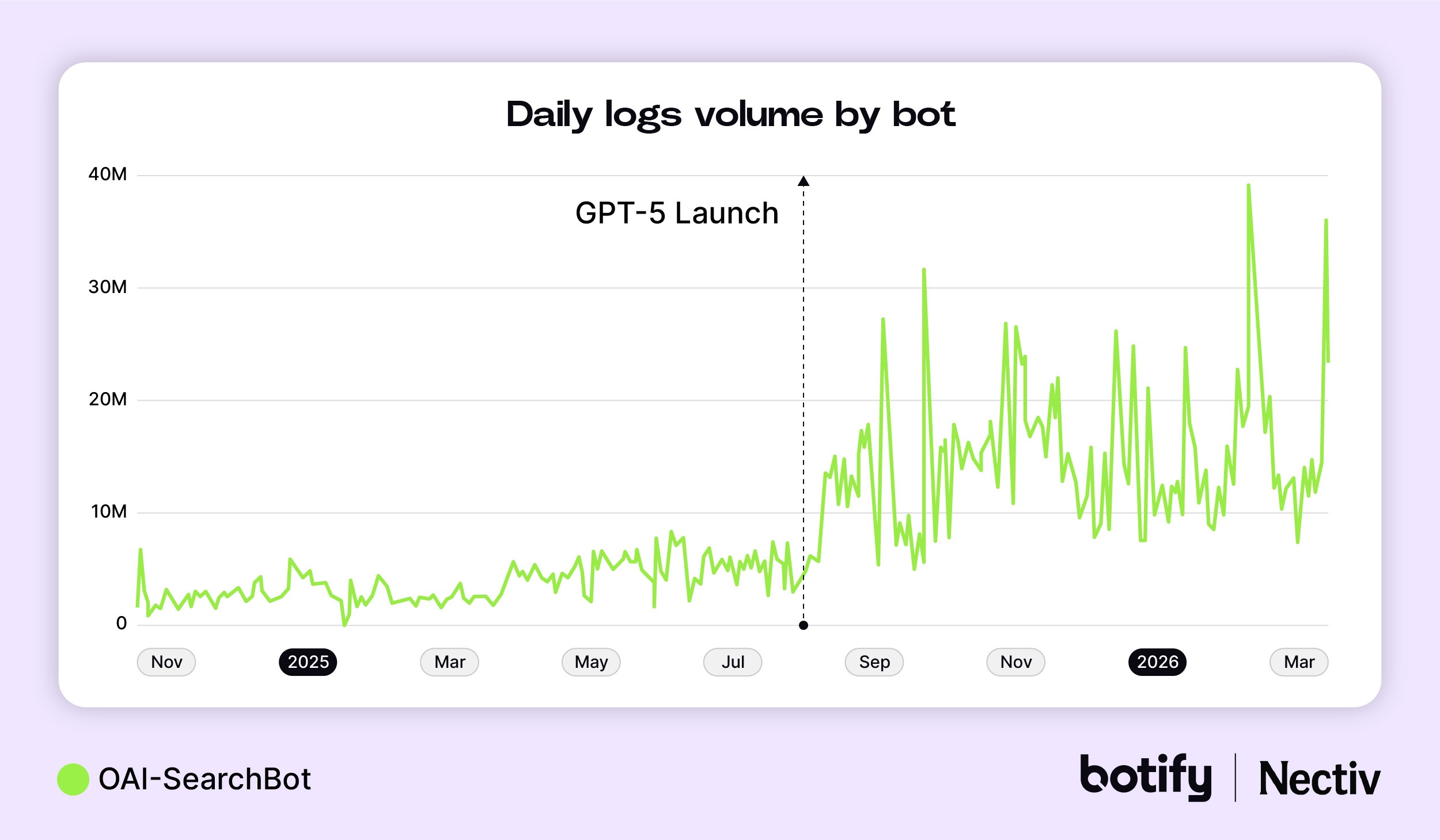
OpenAI Triples Web Crawling Activity Post-GPT-5
BotifyApril 23, 20269 minAn analysis of over 7 billion log files reveals that OpenAI has tripled its web crawling activity since the launch of GPT-5. The data indicates a shift toward real-time web searching via OAI-SearchBot over model training, though this behavior varies heavily by industry. Despite a reported decline in direct ChatGPT user events, OpenAI's crawlers are rapidly closing the crawl volume gap with Google.
Read the full studyWhy it matters: I consider this study the definitive proof you need to show stakeholders that SEO remains critical to AI search. Because ChatGPT is relying on web search more than ever to inform its systems, maintaining a strong traditional organic foundation is directly tied to your visibility in AI engines.
AEO Framework for AI Coding Agents
Addy Osmani (Google Cloud/Gemini Engineer)April 11, 2026Addy Osmani proposes an AEO (Agentic Engine Optimization) framework for AI Coding Agents using clean Markdown and strict token management to ensure technical documentation fits within agent context windows without silent failures. By utilizing signals like llms.txt and skill.md, developers can keep their technical content discoverable and actionable for autonomous coding tools.
Read the full postWhy it matters: I don't recommend prioritizing all these suggestions just yet, as evidence of visibility gains from llms.txt and Markdown is currently inconclusive. However, exploring a Google engineer’s vision for modern crawlability, especially his perspective on tokens, is interesting for navigating the agentic shift. Google has already begun offering Markdown versions of its own documentation with .md.txt urls.
Tech Giants Converge on UCP for Agentic Commerce
News File CorpApril 24, 2026Amazon, Meta, Microsoft, Salesforce, and Stripe have officially joined the Universal Commerce Protocol (UCP) Tech Council alongside founding members like Google and Shopify. This technical body is dedicated to establishing a shared, open standard that allows AI agents to seamlessly handle product discovery, cart building, and checkout across any platform. This collaboration signals a critical industry shift toward a unified ecosystem capable of supporting the complexities of AI-driven shopping journeys.
Read the press releaseWhy it matters: With Google capturing 25% of Generative AI traffic and integrating Gemini directly into Chrome, agentic commerce is becoming an immediate reality. I recommend e-commerce begin adapting their product feeds and technical infrastructures now to ensure they remain discoverable and transactional in this new AI-driven era.
LLM Ads News

OpenAI Introduces OAI-AdsBot for ChatGPT Ads
OpenAI has launched OAI-AdsBot, a web crawler designed to validate the safety and policy compliance of landing pages submitted for ChatGPT ads. The bot also reviews page content to determine ad relevance. The collected data is not used to train generative AI foundation models.
Why it matters: I see this as a clear signal of OpenAI's continued push toward integrating ads into its products while prioritizing quality assurance. It follows the same logic as Google, which uses its own dedicated Google AdsBot to maintain ad standards and safety.
Adobe News
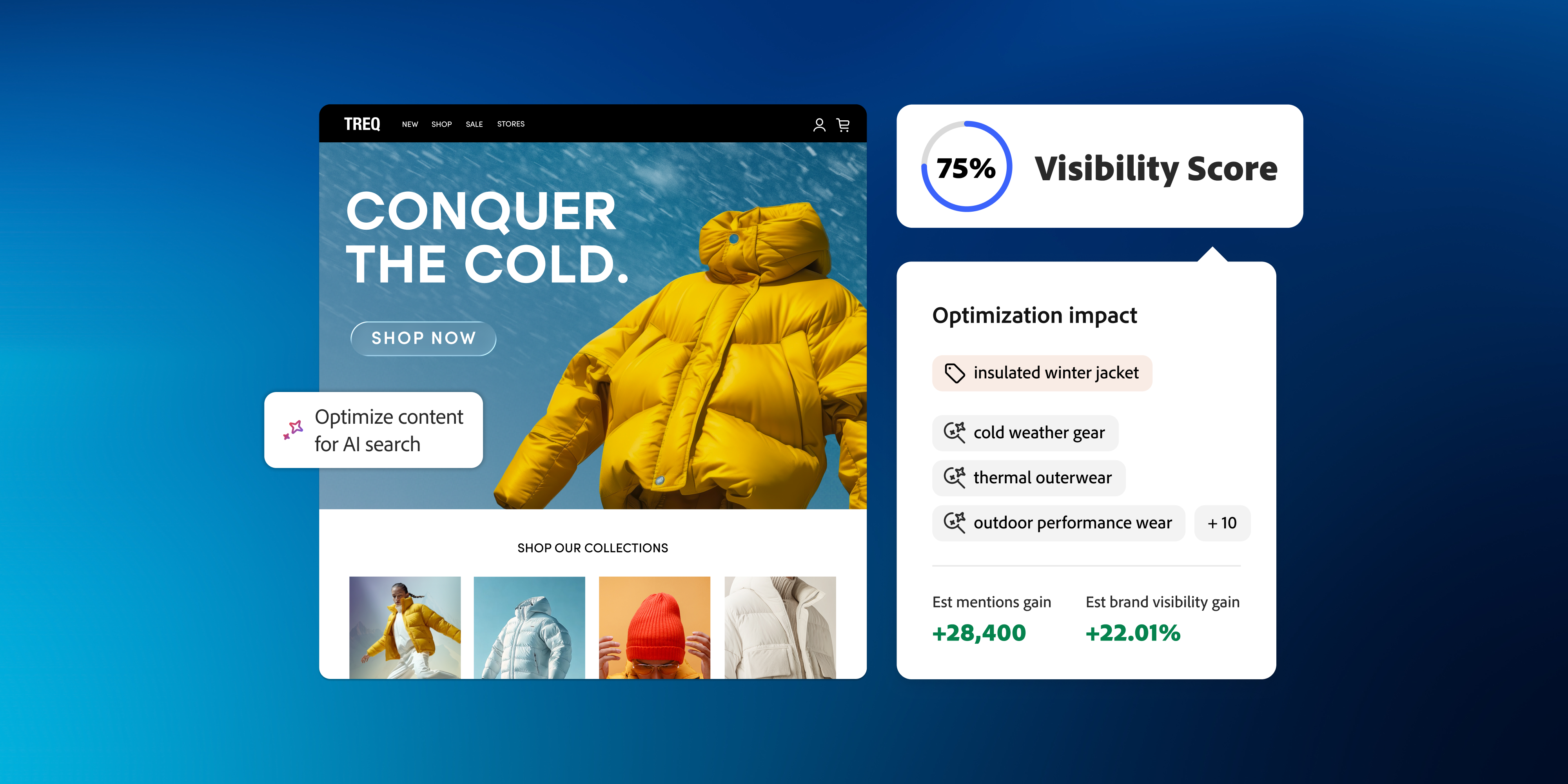
Building a GEO Strategy for the AI-Driven Web
We are shifting the focus of GEO from a one-off project to a continuous, cross-functional practice designed to capture high-converting AI traffic. To make this a reality, our latest update to Adobe LLM Optimizer (now Adobe Brand Visibility) introduces capabilities that let you measure brand claims, deploy no-code edge optimizations, and collaborate seamlessly in shared workspaces.
Why it matters: As part of the team, I see firsthand how crucial it is to bridge the gap between merely analyzing AI visibility and actively improving it. We designed these new features to remove technical bottlenecks, giving teams the power to take immediate, measurable action on their GEO strategies without waiting on development cycles.
Adobe Releases 2026 Q2 AI Traffic Report
Adobe's Q2 2026 AI Traffic Report highlights a massive shift in consumer behavior, revealing that AI-driven website visits now convert at a 37% higher Revenue Per Visit (RPV) than traditional non-AI traffic. This marks a complete reversal from early 2025, demonstrating that AI assistants have rapidly evolved from basic research utilities into high-intent purchase drivers.
Read the full reportWhy it matters: Not investing in GEO is no longer an option. Adobe clearly recognizes this imperative by building tools like Adobe Brand Visibility, providing a straightforward solution for brands worldwide to navigate this critical shift.
Automation News
Claude Code Launches /ultrareview
Anthropic has introduced the /ultrareview command in Claude Code, which launches a remote fleet of reviewer agents to autonomously find and verify bugs in a branch or pull request. This premium, cloud-based workflow provides deeper coverage than local single-pass reviews and runs entirely in a remote sandbox without consuming local terminal resources.
Learning News

High-Converting Landing Pages with Claude Design
This guide outlines a workflow for creating high-converting landing pages using Claude Design without relying on traditional tools like Figma. Users learn to transition from a specific brief to a deployable mockup by utilizing wireframes, inline refinements, and seamless handoffs to Claude Code.
Tools News

Google Launches 'Skills in Chrome'
Google has introduced Skills in Chrome, a new feature allowing users to save and reuse custom AI prompts directly within the browser. This integration enables users to execute repetitive Gemini workflows, such as cross-tab comparisons or data extraction, with a single click across different web pages. It also includes a library of ready-to-use skills to streamline daily productivity tasks.
Why it matters: 1. As Google shifts toward agentic traffic, we must ensure our websites are easily parsable for these new agents, especially since models like Gemini do not execute JavaScript. 2. This feature allows us to build custom SEO/GEO skills that can instantly analyze pages and propose AI optimizations, potentially replacing traditional Chrome plugins.
GitHub Repo - AEO Technical Documentation Audits Tool
Addy Osmani released a new open source tool that allows developers and SEO experts to audit their site optimization for AI coding agents to ensure content is perfectly adapted for consumption by tools like Claude Code or Cursor. This audit is based on five key categories: discovery, content structure, token economics, capability signaling and UX.
Go to Git Repo
Cloudflare Introduces Agent Readiness Score
CloudflareApril 17, 202612 minCloudflare has launched isitagentready.com, a new diagnostic tool designed to help website owners evaluate their adoption of emerging AI agent standards like Markdown content, llms.txt, and API catalogs. The release details how Cloudflare successfully restructured its own developer documentation to be fully optimized for LLMs, resulting in significantly faster and more cost-effective data retrieval. To help businesses capitalize on these developments, Adobe Brand Visibility offers solutions to scale this type of optimization strategy while tracking overall AI visibility.
Test your site's agent readinessWhy it matters: Cloudflare is the second tech player, following Google, to fundamentally restructure its technical documentation using GEO best practices. By releasing a diagnostic tool alongside their methodology, they have provided us with a clear, actionable blueprint to optimize our own content for AI models.
Please note: All opinions and blog posts shared on this website are strictly my own personal projects. They do not represent the views, strategies, or official products of my employer, Adobe.

Hi, I'm Quentin, an SEO/GEO Specialist at Adobe building AI powered tools for Site Optimizer and Brand Visibility. I use this site to document my thoughts on where search is heading in the age of AI, and to share the strategies and shortcuts I rely on.
Connect on LinkedInMore News Digests
SEO, GEO & AI News: October 5th – October 18th, 2026
Stay ahead with the latest SEO & GEO news (October 5th – October 18th, 2026). Insights on AI agents and WebMCP, the ChatGPT UTM bug and Claude's new rules.
SEO, GEO & AI News: June 8th – June 21st, 2026
Stay ahead with the latest SEO & GEO news (June 8th – June 21st, 2026). Insights on Google's May core update, llms.txt reality, and Adobe Brand Visibility.
SEO, GEO & AI News: May 25th – June 7th, 2026
Stay ahead with the latest SEO & GEO news (May 25th – June 7th, 2026). Insights on Google's May core update, the llms.txt debate, and Adobe's Semrush deal.
SEO, GEO & AI News: April 6th – April 12th, 2026
Stay ahead with the latest SEO & GEO news (April 6th – April 12th, 2026). Insights on why robots.txt fails news publishers and the 20% drop in GPT-cited domains.
SEO, GEO & AI News: March 23rd – April 5th, 2026
Stay ahead with the latest SEO & GEO news (March 23rd – April 5th, 2026). Insights on Google’s March Core Update, OpenAI’s strategy, and AI crawler optimization.