SEO, GEO & AI News: October 19th – November 1st, 2026
AI Summary
This post summarizes key industry shifts from October 19th to November 1st, 2026. Quentin Yacoub breaks down Google's poisoned SERPs, Exa's crawler surge, PAO, Google's Connected Apps platform and ads in AI Mode, plus data on how ChatGPT is used at work, ChatGPT's buying forms, JavaScript rendering and the revenue value of AI traffic.

Table of Contents

Cet article est aussi disponible en français : Actualités SEO, GEO & IA : 19 octobre – 1er novembre 2026
AI search is getting harder to measure just as it proves its value. SEO tools now confirm that Google is poisoning SERPs, Mike King warns that generative pages will break rank tracking, and Marie Haynes calls GEO a distraction because Google drives 99% of search traffic.
Yet AI traffic keeps gaining value: Adobe finds it earns US retailers 83% more per visit, and GPT-6 lifted ChatGPT referral visits.
The agentic web also kept taking shape: I proposed a name for optimizing for personal agents (PAO), Exa’s crawler now outpaces OAI-SearchBot and ClaudeBot on Adobe customer sites, agents reached 0.68% of US ecommerce orders, Sundar Pichai (Google’s CEO) expects them to use both pages and protocols, and Google launched Connected Apps on MCP while bringing ads in AI Mode to 10 new countries.
On the practical side, you’ll also find the questions ChatGPT asks buyers before recommending a product, Glenn Gabe’s JavaScript tests, DEJAN’s CHISEL concept and the Arachnide crawler. Dive in for what each shift means for your SEO and GEO strategy.
Have feedback on this digest? Connect with me on LinkedIn.
SEO News
SEO Tools Confirm Google Is Poisoning SERPs
The main SEO tools now confirm that Google serves altered results to suspected scrapers. Ahrefs sees 5% to 20% of results affected depending on the data provider, Semrush says it has filtered them since late summer with limited impact, and SE Ranking reports about 2% still affected.
Why it matters: The tools now confirm what Nozzle measured in the last edition. I predicted then that, with Google locking its results, AI companies would build their own indexes or turn to providers like Exa.
Exa Now Crawls Adobe Customer Sites More Than OAI-SearchBot and ClaudeBot
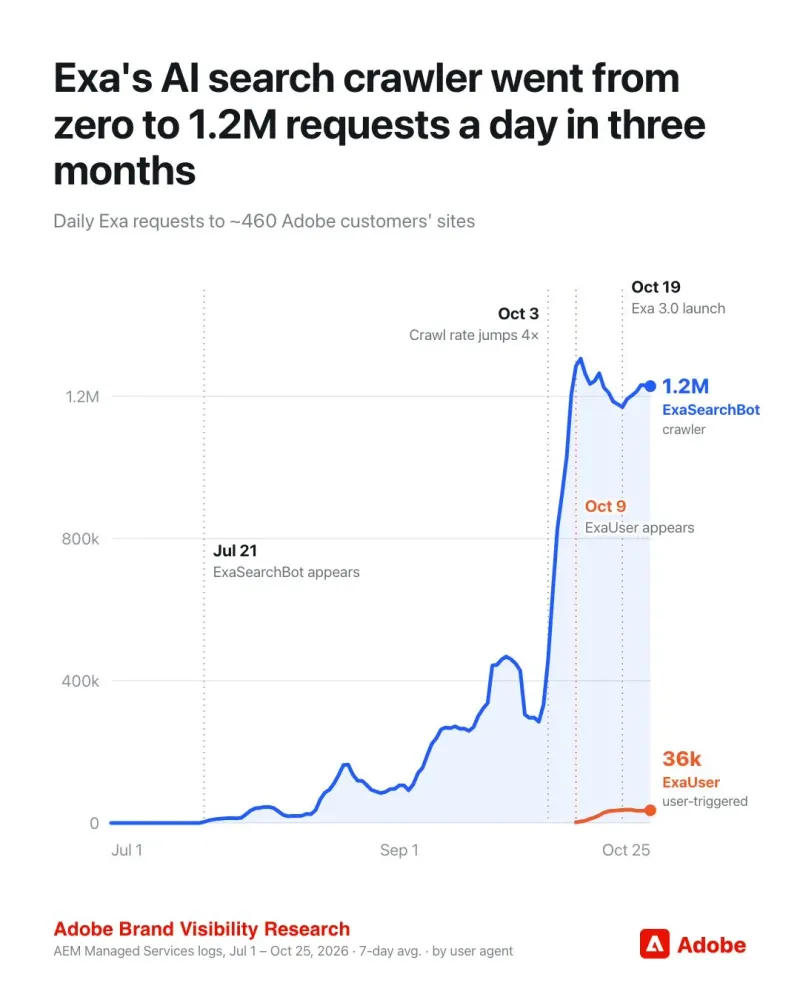
Quentin YacoubOctober 27, 2026In the logs of about 460 sites on AEM Managed Services, ExaSearchBot went from zero to 1.2 million requests a day in three months, becoming the fourth most active crawler, ahead of OAI-SearchBot and ClaudeBot. Exa sells access to its index through an API, and personal agents like Instinct already fetch pages through it as ExaUser.
Read the LinkedIn postWhy it matters: When an agent searches the web for someone, your page may now be found through Exa, not Google. I would track Exa's hits in your logs and keep the pages it crawls up to date, then query its API: unlike ChatGPT or Claude, it lets you see which pages come up for your topics.

Generative SERPs Will Break Rank Tracking
Mike KingOctober 15, 2026Mike King argues that as Google moves toward generative UI, where a model builds the results page for each query, presentation changes but retrieval does not, so what breaks is measurement. In Google's own research, human evaluators preferred the generated page over the top search result 90% of the time on LMArena prompts and 73.5% on information-seeking prompts. He recommends sampling SERPs several times a day, reporting visibility as a rate with its spread, and anchoring every rank tracker to Search Console.
Read the full postWhy it matters: AI Overviews make rank tracking harder, and trackers are already shaken by the poisoned SERPs Google serves them. But do positions still matter in a search world powered by AI? I do believe the 10 blue links will disappear, but generating every SERP from scratch would be too costly for Google given billions of searches a week; I expect precomputed conversational results instead, so some tracking may remain.
GEO Is a Distraction, Google Still Drives 99% of Search Traffic
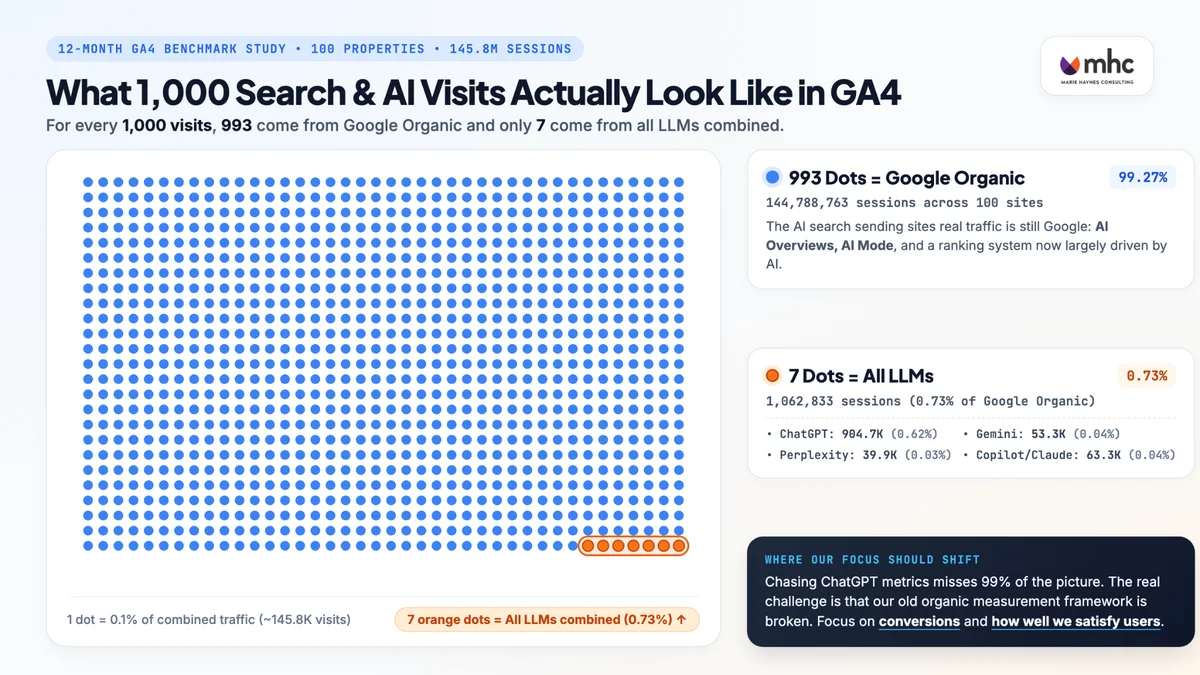
Marie HaynesOctober 21, 2026Across 12 months of GA4 data from 100 sites, ChatGPT sent just 0.62% of Google organic's traffic, and Google drove 27 times more conversions despite ChatGPT's higher conversion rate. Marie Haynes argues the real opportunity lies in Google's AI surfaces and the agentic web.
Read the full postWhy it matters: I agree with Marie that Google remains unavoidable, but traffic isn't the whole story. As Mike King replied, AI search works as a brand channel, and GA4 undercounts it anyway: tracking breaks, and people who ask an LLM often finish on Google with a branded search, which counts as organic.
Google Moves Posts Higher Up in the Local Knowledge Panel
Search Engine RoundtableOctober 19, 2026Google is moving the Google Posts section of the local panel back up, after sending it to the bottom in 2018. Ben Fisher spotted the test, with posts alternating between the higher and lower positions every 3 days.
Read the full postWhy it matters: Google Posts are an underused local SEO lever: they add keywords to a Business Profile, prove it's active and open a direct line with customers. At Decathlon, publishing one post a week on every store's profile became one of my most effective local routines.
GEO News
ChatGPT, Claude and Perplexity Still Can't Render JavaScript
Glenn Gabe retested 3 JavaScript setups 434 days after his first study: ChatGPT, Claude and Perplexity still failed every test, while Gemini and Copilot, backed by Google and Bing rendering, read the content. Copilot itself failed on a WebGL parallax site.
Why it matters: This means that if your content is rendered client side, it's invisible to AI. My prediction didn't hold: I expected AI crawlers to render JavaScript at some point, and they still can't. Client-side rendering is still not an option; if you can't avoid it, Adobe Brand Visibility's Recover Content Visibility fixes it at the edge.
Workers Use ChatGPT More to Decide and Create Than to Search
OpenAI SignalsOctober 26, 2026OpenAI Signals now maps work-related ChatGPT messages to 165 activities in nearly 100 countries. In the US in Q3 2026, making decisions accounts for 18.9% of messages and thinking creatively for 18.5%, up from 11.8% in early 2025, while getting information fell to 9.9%. The data excludes Enterprise plans and Codex.
Read the full studyWhy it matters: Even though it only covers work use, this data shows what people actually ask ChatGPT and how that changes over time. If you do prompt tracking, use these categories to build your prompt corpus, rather than tracking informational queries alone.
ChatGPT Questions Buyers Before Recommending, and Fills In the Form Itself
Mathias Ptacek (Rankscale)October 21, 2026Across 7,313 ChatGPT answers to buying prompts in Germany, the UK and the US, 79.4% came with a follow-up form asking for budget 87% of the time and brand 0.4%, plus product-specific questions such as terrain and experience level for running shoes, or use case and operating system for laptops. Mathias Ptacek found 86.5% of forms arrive already filled in, with the middle price band pre-selected nine times in ten.
Read the full studyWhy it matters: For e-commerce, this form is a free brief: it lists the questions shoppers care about, market by market. I would check three things: can your category filters handle those options, are the answers written on product pages rather than implied by a photo, and does your feed carry them as structured attributes, with current prices and size variants?
Claude Quietly Switched to a New Search Index
WritesonicOctober 20, 2026Writesonic found that since October 5, Claude's default search mode runs on a new index that is neither Brave nor Parallel, while an extended mode stays closer to the old one. Across 50 prompts, the two modes shared only 10% of cited domains; Wikipedia and Forbes almost disappear from default answers, replaced by directories and small review sites.
Read the full studyWhy it matters: Claude switching its index is the AI equivalent of a Google core update: it reshuffles who gets cited. It's too early for specific tactics. For now, I'd track both modes side by side (adding
(extended mode)to the prompt forces it) to see which sources each one cites, then go back to the classic GEO playbook.DeepSeek Opens Its Search Engine to SEOs With a Public API
Suganthan MohanadasanOctober 19, 2026DeepSeek opened its in-house search engine through a public Search and Fetch API that shows an authority score and a rerank score for every result. Suganthan Mohanadasan's tests show authority behaves like a host score, date filters drop undated pages, and the fetcher poses as Firefox and ignores robots.txt.
Read the full postWhy it matters: Looking under the hood of an AI search engine is always instructive. I would ignore the authority score, a DeepSeek-specific PageRank, but undated pages being dropped is a quick fix worth making. The robots.txt finding doesn't surprise me: the CDN or firewall remains the reliable way to block AI.

Cloudflare Helped OpenAI Index Millions of New Pages
CloudflareOctober 15, 2026A research pilot gave OpenAI's search crawler signals from Cloudflare's network. On about 1% of that network, it helped OpenAI discover and index hundreds of millions of new pages for ChatGPT Search. These are pages few sites link to, even though people need them, like a product manual or a restaurant menu.
Read the full postWhy it matters: If this pilot expands, a CDN becomes a GEO lever: sites behind Cloudflare could be discovered and refreshed faster by ChatGPT, especially deep, poorly linked pages. That said, being indexed doesn't guarantee a citation, but a page OpenAI has never seen can't be cited anyway.
GPT-6 Lifted ChatGPT Referrals
Cedric Huesler (Adobe)October 20, 2026Comparing four weekdays before and after GPT-6 across thousands of domains, my colleague Cedric Huesler measured 26% more ChatGPT-tagged visits while search fell 6%. Homepage visits jumped 160% and support and store locator pages over 50%, while product pages barely moved.
Read the LinkedIn postWhy it matters: More traffic from LLMs is good news. GPT-6 itself may drive it, or the way ChatGPT now displays links, which strongly affects click rates. These gains tend to swing from one model to the next, so I hope this one lasts.
Chris Green Warns Against Building a Shadow Web for AI
Chris GreenOctober 22, 2026Chris Green separates serving the same content in agent-friendly formats (llms.txt, Markdown, feeds), which he supports, from publishing information only AI can see, which he likens to cloaking. Search engines spent years penalizing it, and AI providers have the same incentive to distrust sources users can't verify.
Read the full postWhy it matters: Serving AI a different, enriched version of your content is tempting, and it works for now. Experience tells me it won't last: AI platforms will start penalizing it, as Google did. On my site, Exa's crawler fetches each page twice in a row, first requesting Markdown, then HTML; comparing the two is already technically possible.
Personal Agent Optimization News
How to Optimize Your Website for Personal AI Agents
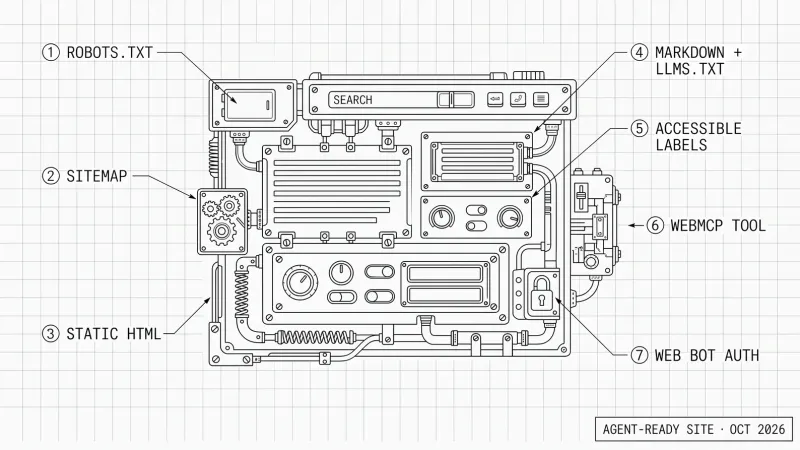
Grok Bot, Muse and OpenAI Dots now use websites on people's behalf, so I propose a name for optimizing for them: PAO (Personal Agent Optimization). My article covers access, the main agent protocols, why accessibility comes first, what Muse did on my site and how to track agents.
Why it matters: Personal agents are taking off: Meta Muse passed 10 million downloads in 40 days and 2.5 million daily users. Now is the time to make sure your site actually works for them.
Agents Now Handle 0.68% of US Ecommerce Orders, Driven by Meta Muse
First Page SageOctober 22, 2026First Page Sage puts agents at 0.68% of US ecommerce orders in Q3 2026, up from 0.27% in Q2, with 71% of that rise tracing to Muse. Its definition is broad: it also counts orders where the agent only builds the cart. While 61.4% of shoppers use AI to research purchases, only 6.8% have let an agent complete a checkout.
Read the full studyWhy it matters: Agentic commerce is still small, but it's growing fast, especially with Muse. I'm following it closely: I expect it to reach several percent of orders within months, and at 2% or 3% of an ecommerce site's sales, it will justify real investment. Meanwhile, 61% of shoppers already research with AI, another metric that proves GEO matters.
AI Agents Will Use Both Pages and Protocols
Matt G. Southern (Search Engine Journal)October 22, 2026Sundar Pichai (Google's CEO) expects AI agents to reach websites two ways: browsing pages like a user, and through protocols such as MCP and Google's Universal Commerce Protocol (UCP). He sees protocols as far more scalable but slower to build, so agents that browse sites like humans, such as Google-Agent, will stay in the picture meanwhile.
Read the full postWhy it matters: I agree with Sundar: to win the personal agent market, tech giants can't wait for sites to ship MCP servers or other protocols. Agents will keep using the web as it is and sites that optimize for personal agents will likely see fewer failed tasks and more conversions.
Google Launches a Connected Apps Platform Built on MCP
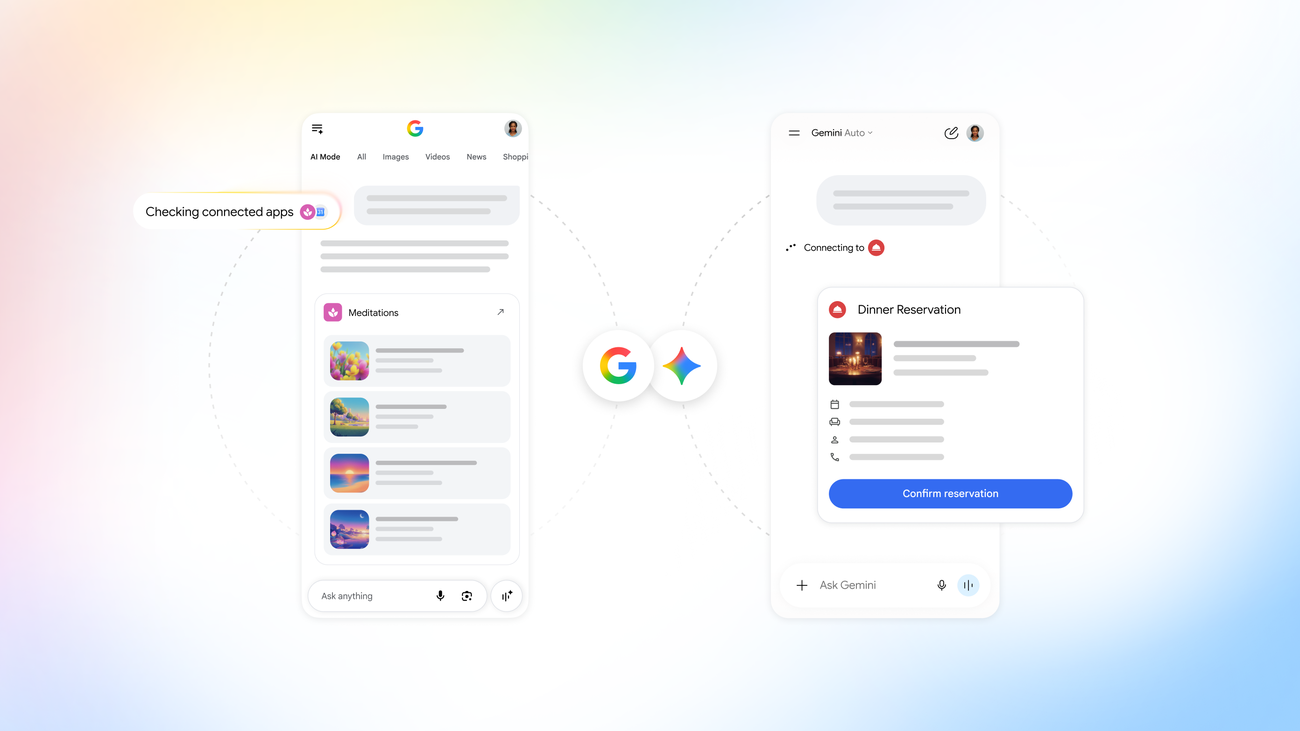
GoogleOctober 28, 2026Google launched a preview of its Connected Apps Platform, which lets a service act directly inside Search and Gemini. A company exposes what it can do (ordering, booking, checking an account) through an MCP server and submits its app to Google. Users link it once, then ask Google to act for them. More than 50 apps are live, with Adobe, Experian, Localiza and Peloton coming to Search.
Read the announcementWhy it matters: Another sign that tech giants are taking the agentic web seriously. An MCP server connected to this platform lets Google's agents interact directly with your service. It's not mass market yet: few companies have access, though developers can apply, and users only find these apps in AI Mode, in the US and in English. But to me, this looks like the future.
LLM Ads News
Google Brings Ads in AI Mode to 10 New Countries
Google is rolling out ads in AI Mode to Australia, Canada, India, Kenya, Malaysia, New Zealand, Nigeria, Pakistan, the Philippines and Singapore. Brazil, Mexico and the UK are planned for Q4 2026. In the US, multiturn ads will also appear on follow-up queries. They carry a "Sponsored" label.
Why it matters: On its Q3 earnings call, Google admitted AI Mode monetizes less than classic Search, and says its research shows people are comfortable with these ads. Personally, I don't like ads in AI answers, even when they match my intent. But I get it: these answers are expensive to produce and someone has to pay for them.
Adobe News

AI Traffic Now Earns US Retailers 83% More Per Visit
Across more than 1 trillion US retail visits, Adobe found AI traffic up 71% year over year in September, converting 90% better and earning 83% more per visit than non-AI traffic. These visitors also spend 73% more time on site, view 25% more pages per visit and add to cart 53% more often.
Why it matters: This backs up Marie Haynes' data: visits from LLMs are more valuable and more engaged, because shoppers have already done their research and arrive qualified. Volumes are still low, but the growth is impressive.
Tools News
DEJAN's CHISEL Measures Which Sentences Earn a Page Its AI Citation
Dan Petrovic's research shows that when an AI cites several sources, a page's rank among them comes down to a few specific sentences, not the whole page, and he built a tool to find which ones. Across 111 runs on Google, ChatGPT and Claude, sentences naming the prompt's topic and the opening line weighed most, while repeating the brand barely counted.
Why it matters: Knowing which passage of a page drives a mention or citation is essential for two reasons: correcting it when the AI repeats an error, and optimizing the sentences that carry the weight. The edit test proves it works: once competitors added the leader's two best lines, four of five ranked first at least once.
Arachnide, a Free Open-Source SEO Spider You Can Plug Into Your AI Agent
Thierry GustinOctober 20, 2026Thierry Gustin's Arachnide is a free, MIT-licensed SEO crawler that runs locally like Screaming Frog, with about 90 SEO and GEO checks, JavaScript rendering and a prioritised action plan. Version 3.13 lets Claude, ChatGPT or n8n drive it through MCP or a REST API, and adds a 0-100 GEO readiness score.
Go to the GitHub repo
Please note: All opinions and blog posts shared on this website are strictly my own personal projects. They do not represent the views, strategies, or official products of my employer, Adobe.

Hi, I'm Quentin, an SEO/GEO Specialist at Adobe building AI powered tools for Site Optimizer and Brand Visibility. I use this site to document my thoughts on where search is heading in the age of AI, and to share the strategies and shortcuts I rely on.
Connect on LinkedInMore News Digests

SEO, GEO & AI News: October 5th – October 18th, 2026
Stay ahead with the latest SEO & GEO news (October 5th – October 18th, 2026). Insights on AI agents and WebMCP, the ChatGPT UTM bug and Claude's new rules.

SEO, GEO & AI News: June 8th – June 21st, 2026
Stay ahead with the latest SEO & GEO news (June 8th – June 21st, 2026). Insights on Google's May core update, llms.txt reality, and Adobe Brand Visibility.

SEO, GEO & AI News: May 25th – June 7th, 2026
Stay ahead with the latest SEO & GEO news (May 25th – June 7th, 2026). Insights on Google's May core update, the llms.txt debate, and Adobe's Semrush deal.

SEO, GEO & AI News: April 13th – April 26th, 2026
Stay ahead with the latest SEO & GEO news (April 13th – April 26th, 2026). Insights on OpenAI’s crawling surge, Gemini's market share, and agentic commerce.

SEO, GEO & AI News: April 6th – April 12th, 2026
Stay ahead with the latest SEO & GEO news (April 6th – April 12th, 2026). Insights on why robots.txt fails news publishers and the 20% drop in GPT-cited domains.