SEO, GEO & AI News: November 2nd – November 15th, 2026
AI Summary
This news digest summarizes key industry shifts from November 2nd to November 15th, 2026. Quentin Yacoub lists OpenAI's Business Hub and ChatGPT Wallet, Google's ranking signals and twiddlers, Gemini 4 Hydrogen in Search, Bing's Topics Portfolio and Reddit Reviews, plus data on AI citation volatility, and explains why each shift matters for SEO and GEO.

Table of Contents
Cet article est aussi disponible en français : Actualités SEO, GEO & IA : 2 novembre – 15 novembre 2026
OpenAI is now building both sides of a marketplace. Business Hub gives brands first-party data on how ChatGPT cites them, ChatGPT Wallet lets agents pay on a user’s behalf, and ChatGPT Ads rewrites ads by default. And Bing, for its part, shows the AI queries where your site isn’t cited!
On Google’s side, Olivier de Segonzac lifted the lid on how Google ranks pages, from its 305 sets of ranking signals to the 120 twiddlers that rework results afterwards. Gemini 4 Hydrogen, Google’s biggest model upgrade to Search, may also reshuffle who gets cited in AI answers, while scrapers pushed out of Google move to Brave and Bing.
Measuring AI visibility remains tricky: Ahrefs shows that most AI citations vanish overnight before coming back, SISTRIX finds that classic SEO still gets pages cited, and Reddit turns its threads into product review pages.
On the practical side, you’ll also find Claude auto-connecting MCP connectors, WebMCP’s new outputSchema, Screaming Frog 25 driven through MCP, a DEJAN model that classifies the sentiment of AI answers and a free Claude skill from Chris Long, plus Adobe’s take on AI agents.
Dive in for what each shift means for your SEO, GEO and PAO strategy.
Have feedback on this digest? Connect with me on LinkedIn.
SEO News
Google Records 305 Sets of Ranking Signals
Starting from Google's code, Olivier de Segonzac lists 305 sets of ranking signals that Google Search records: 167 for each result and 138 for each query. 48 apply to a web page, from rankers to expertise, topic authority, freshness and demotions, and 34 are used by AI Overviews and AI Mode.
Why it matters: Knowing the factors behind Google's ranking has always been useful, and now we can hand this list to an AI to audit our pages against the signals that apply to them.
Google Uses 120 Twiddlers, Programs That Rework Results After Ranking
Olivier de Segonzac (RESONEO)November 3, 2026Olivier de Segonzac found 120 twiddlers across web, image and video search: small programs that rework Google's results after ranking, moving a page up or down or removing it. Among them: AI Mode's fan-out search plan, a filter still named after Bard, an expertise twiddler computed page by page, one that pushes down results you've already seen when you repeat a query, and a site-wide demotion past a certain volume of DMCA notices.
Read the full studyWhy it matters: Another great study from Olivier de Segonzac, who has been on fire these past two weeks. Understanding twiddlers means understanding part of Google's algorithm: a position is still decided after the initial score.
Pushed Out of Google, Scrapers Move to Brave and Bing
BraveNovember 11, 2026Since Google started routing its results through google.com/goto links and serving poisoned SERPs, the scrapers that resell search results to chatbots and AI agents have moved elsewhere. Brave saw spikes of several thousand requests per second and will now encrypt its result links. Bing fights back too: Kevin Indig found that 55.7% of Bing results returned by SerpApi on his test queries looked poisoned, against 10.1% on Google.
Read Brave's postWhy it matters: Search engines now treat their results as a resource to protect from AI scrapers, so the data behind many rank trackers and AI tools is getting less reliable. It also confirms what I predicted two editions ago: AI companies will lean on their own indexes or on providers like Exa, whose crawler already visits Adobe customer sites more than OAI-SearchBot and ClaudeBot. Brave counts too: in June, 79% of Claude's citations came from its top 10.
Google Moves Brand AI Overviews to the Right Column
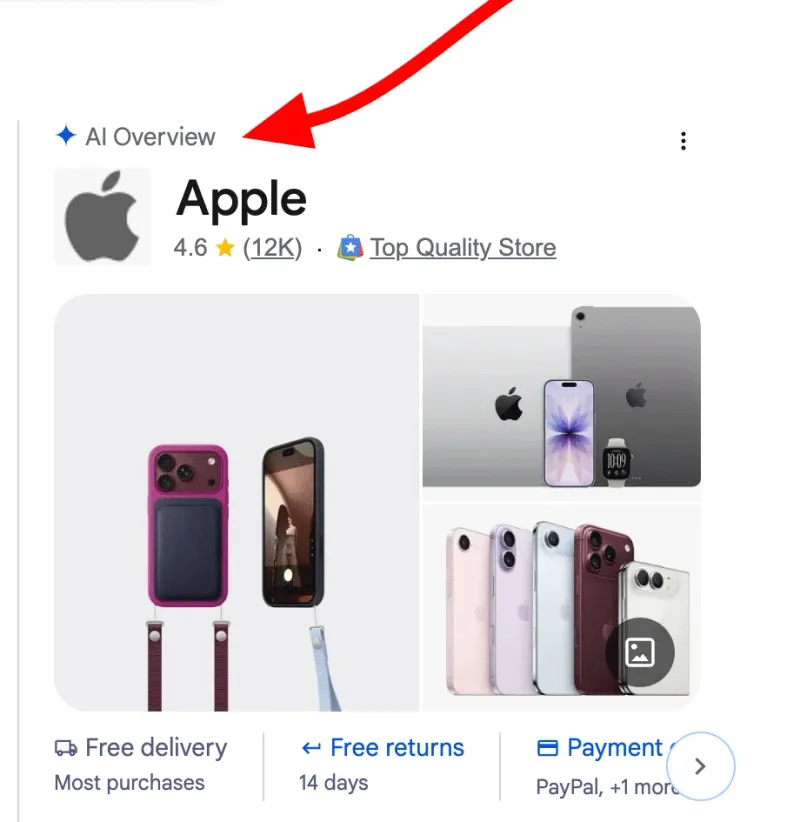
Search Engine RoundtableNovember 2, 2026For many brand searches, like [Adobe] or [Apple], Google now shows the AI Overview in the right column, where the Knowledge Panel sits, instead of at the top of the main results.
Read the full postWhy it matters: Good news: Google pulled the AI Overview from the top of brand results. In my view, it doesn't belong in the Knowledge Panel either. People who search for a brand mostly want to reach its website, and an AI Overview can get things wrong by mixing various sources.
GEO News
OpenAI Launches Business Hub!
With Businesses in ChatGPT, any eligible business can claim its ChatGPT profile, update its description, category, logo and product feeds, and see first-party insights from OpenAI: mentions, clicks to its site and discovery topics, the themes of the conversations where ChatGPT cites it. Eligible US e-commerce and online service businesses can also build a Business Agent that answers customer questions.
Why it matters: It's the first-party data the GEO industry was waiting for, but read it carefully. A Business Hub "mention" only counts when ChatGPT links to your site, so when the link for your brand name goes to G2 or another website, it doesn't count. It also opens new optimizations for GEO experts: the profile, the product feeds and the Business Agent all become levers to work on.

Bing Shows the AI Queries Where You're Not Cited
Bing Webmaster BlogOctober 13, 2026Topics Portfolio, in the AI Performance report of Bing Webmaster Tools, groups the grounding queries that cite your site into topics, with each topic's AI search demand, how many sites compete for it and its number of queries. For each topic, it also lists opportunity queries where other sites get cited and yours doesn't, with citation volumes shown as ranges.
Read the announcementWhy it matters: This one slipped through the net in October, but it's too useful to skip. Like Business Hub, it's first-party data straight from the engine, and Bing goes further by showing the queries where you're not cited: a ready-made content plan for AI search.
Gemini 4 Hydrogen Now Powers Google Search's AI Answers
Robby Stein (Google)November 12, 2026Google is bringing Gemini 4 Hydrogen to Search globally, which it calls its biggest model upgrade to Search yet. The model handles complex, multi-part questions, runs a broader query fan-out that links to more sites, and gives more visual answers with images, comparison tables and custom tools, in every language AI Mode supports.
Read the announcementWhy it matters: Model changes are always worth noting: they can explain sudden shifts in which sites get cited. For AI answers, it's the equivalent of a core update, and a broader fan-out may bring new sites into the answers.
OpenAI Says ChatGPT's Search Volume Is About 20% of Google's
Big TechnologyNovember 3, 2026Adam Fry, ChatGPT's consumer product lead, told Alex Kantrowitz that ChatGPT's volume of search-like queries is now roughly one-fifth of Google's, a year and a half after it gained web search. ChatGPT also grew from 1 billion to 1.2 billion weekly users in two months. OpenAI counts a search each time ChatGPT goes to the web, but hasn't shared its method.
Read the full interviewWhy it matters: If the figure holds, ChatGPT already handles several times Bing's volume, since Bing has about 5% of the search market. But it's OpenAI's own number, with no method shared, and a single conversation can hold several searches, up to a dozen if each fan-out query counts.

Reddit Turns Community Threads Into AI-Generated Product Review Pages
RedditNovember 10, 2026Reddit is testing Reddit Reviews: AI organizes community discussions into product review pages with a "what people are saying" summary, the share of positive, mixed and negative conversations, recurring themes and links to the original threads.
Read the announcementWhy it matters: Reddit is turning its discussions into structured review pages, product by product and at scale: a format G2 made popular, and one that AI answers readily cite. For brands, checking these summaries will become essential, since AI relies heavily on Reddit to form an opinion of a brand.
Most AI Citations Vanish Overnight, Then Come Back
AhrefsOctober 29, 2026Ahrefs asked five AI tools the same questions every day for 20 days: more than half of the citations were gone the next day, but about 75% of those came back during the study, and a citation that had held for 8 days or more almost always returned. Brand mentions proved more stable than links, and pages that rank in Google kept their citations longer.
Read the full studyWhy it matters: We see the same trend in Adobe Brand Visibility, which is why we recommend several weeks of tracking before drawing firm conclusions. It also depends on your prompt set: branded prompts stay far more stable than non-branded ones like "best X".
SISTRIX Tests GEO Tactics on 96,418 URLs
SISTRIXOctober 22, 2026SISTRIX compared 48,527 pages cited by ChatGPT, AI Mode or AI Overviews with uncited pages from the same domain, to find what makes one page get cited over another. A table of contents (cited 1.7 times as often), Article schema (1.6), FAQ schema (1.5) and an author box with photo (1.4) stand out, and pages that combine many of these features are cited 2.1 times as often.
Read the full studyWhy it matters: What stands out is pure SEO, the kind we were doing long before the GEO hype: structured data, a table of contents and proof of authority. Nothing new, but it's always good to have a study showing it still works.
What Google's AI Overviews and AI Mode Read Before They Answer
Olivier de Segonzac (RESONEO)November 5, 2026Olivier de Segonzac again in this edition, with a study of Google's internal schemas showing that AI Overviews and AI Mode read far more than web pages, and only one of their nine source types is a link to a site. A fact known only to the Knowledge Graph reaches the answer with no link, so the study advises fixing your entity at the source and stating key facts on your own pages to win back the citation.
Read the full studyWhy it matters: The Knowledge Graph Search API is underused: in seconds, it shows whether Google recognizes your brand as an entity and how it describes it. That is the first check to run before fixing anything.

Structured Data Doesn't Reach AI Overviews Directly, the Knowledge Graph Does
Natzir TurradoOctober 27, 2026Starting from a Google intern's CV, Natzir Turrado shows that Google turns Knowledge Graph facts into sentences and passes them to its AI as search results with no URL. His conclusion: schema.org markup doesn't directly influence AI answers; it feeds the Knowledge Graph, where consistency across sources matters most.
Read the full postWhy it matters: I admire this kind of work. And it shows that structured data optimization is not a thing of the past: Google still uses it, through the Knowledge Graph, to better understand a page.
Personal Agent Optimization News
Claude Now Auto-Connects MCP Connectors
In Claude, companies on Team and Enterprise plans can now connect tools like Notion, HubSpot or Semrush for the whole team at once: each employee finds them already connected, with no sign-in and no "Allow" button to click. The tool has to support it on its side: 14 already do, and any MCP server provider can add it.
Why it matters: Each friction removed brings us closer to the next step: AI agents that find the MCP server of the site best placed to answer and simply ask the user's permission to use it. No app to submit, no setup. Is it time to build your MCP server, document it and list it in MCP directories? I would say yes, and it's my next test.
ChatGPT Wallet Lets Agents Pay for You
OpenAINovember 13, 2026Built with American Express, Mastercard and Visa, ChatGPT Wallet lets an agent pay on a user's behalf: the user approves each purchase with Face ID or a fingerprint, and the merchant receives a payment token instead of the card details. OpenAI's playbook asks merchants to claim their business in ChatGPT, let agents signed with Web Bot Auth through their firewall and add WebMCP tools.
Read the announcementWhy it matters: OpenAI wants purchases to happen without leaving its platform. Together with Business Hub, it now stands at both ends of the chain, like a marketplace: services for sellers on one side, for buyers and their agents on the other. The open question is whether OpenAI will stick to subscriptions and ads, or end up taking a cut of each sale, like Amazon or Walmart.
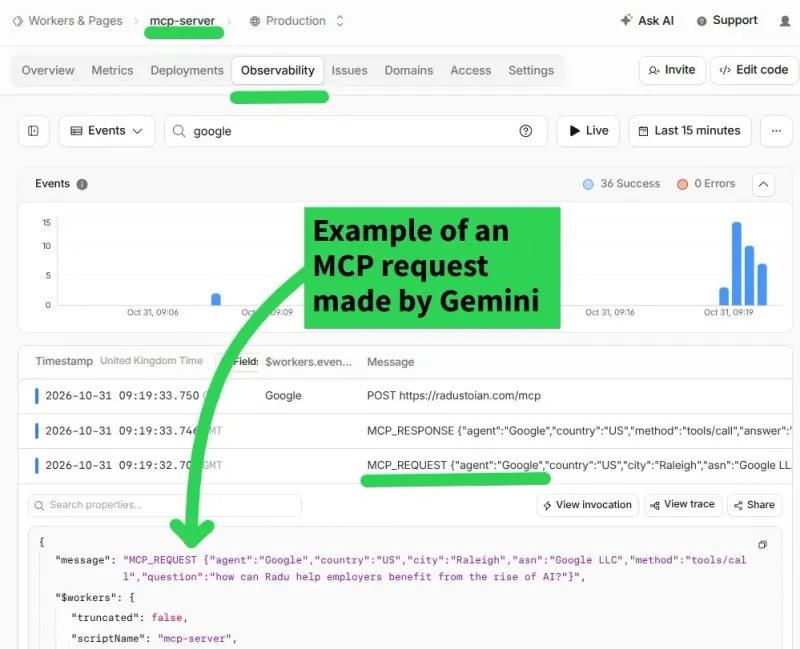
Radu Stoian Logs Gemini Calling His MCP Server
Radu StoianOctober 31, 2026Radu Stoian argues that analytics must stop filtering out AI agents: when an agent reads your site or calls your MCP server for a user, the human intent is still there. He shares a real Gemini request to his own MCP server and is building a setup that streams this agent traffic into BigQuery, next to human visits.
Read the LinkedIn postWhy it matters: I totally agree with Radu, and I do the same on my site: a Cloudflare Worker logs AI bot visits, calls to my WebMCP tool and conversations with my A2A agent. This data doesn't replace human visits; it shows how agents actually use the site.
WebMCP Tools Can Now Describe What They Return With an outputSchema
WebMCP spec (W3C Web Machine Learning group)November 2, 2026The WebMCP spec now lets a site add an optional
outputSchemato the tools it registers withdocument.modelContext.registerTool(), describing in JSON Schema what each tool returns, as MCP already does. The browser doesn't enforce it yet: the spec hasn't settled who should validate, so for now the agent integration checks each result and sends any mismatch back to the model as an error.Read the spec changeWhy it matters: An agent that knows the exact shape of a tool's answer makes fewer mistakes with it. For my own WebMCP tool, it's a quick win: describe the list of news it returns, so agents read the results without guessing.
LLM Ads News
ChatGPT Ads Now Rewrites Ads and Changes Their Landing Pages by Default
Since October 30, OpenAI turns on creative enhancements by default for new and existing self-serve ChatGPT Ads campaigns. The system can rewrite headlines and descriptions to fit the conversation, translate them, resize images and send the click to another page of the advertiser's site. These versions run without review or preview, and advertisers can opt out in Ads Manager, at the account or campaign level.
Why it matters: It's the ChatGPT equivalent of Google's AI Max. Paid specialists now have to watch the same things as SEO and GEO specialists, page quality and accurate information, since ChatGPT rewrites the ad and picks the landing page from the site's content.
Adobe News
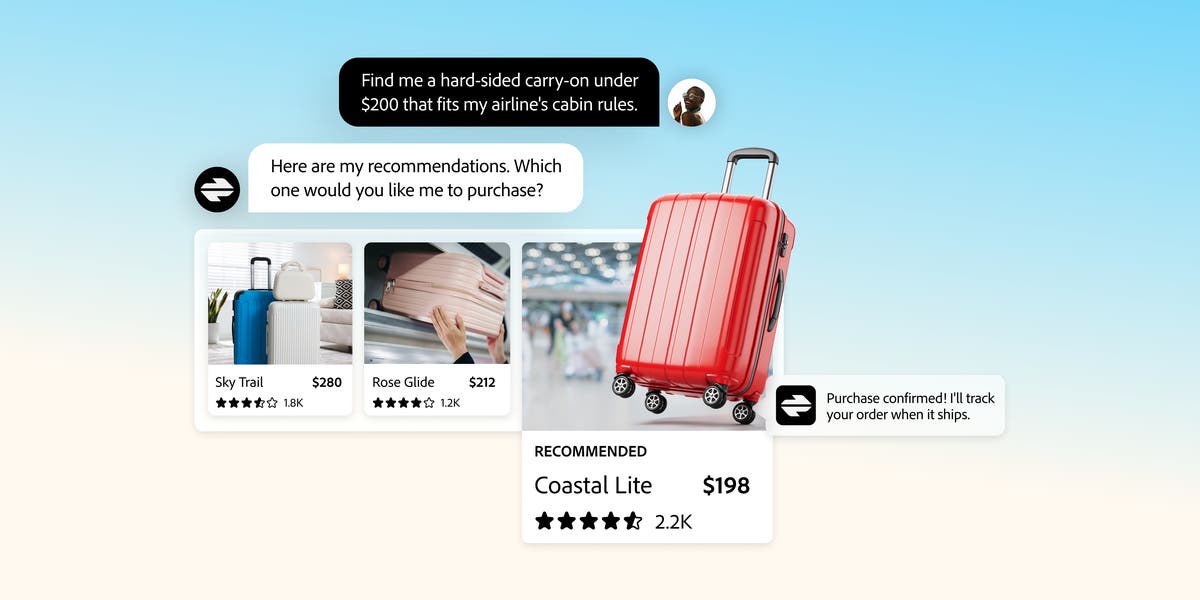
Adobe: Your Next Website Visitor May Be a Customer's AI Agent
Kathie Yang explains that websites now serve two audiences: people and the agents acting for them. Testing Meta's Muse on a cruise booking, Adobe saw the agent read the page structure, check the facts and move on when it couldn't verify an offer or finish the booking. A price in an image, a date picker it can't operate or a page that shifts while loading quietly sends the sale to a competitor.
Why it matters: It's the approach I described in my article on personal AI agents: accessibility, page structure and performance decide whether an agent completes a purchase. And unlike a person, an agent that fails leaves no trace in your analytics; it just recommends another brand.
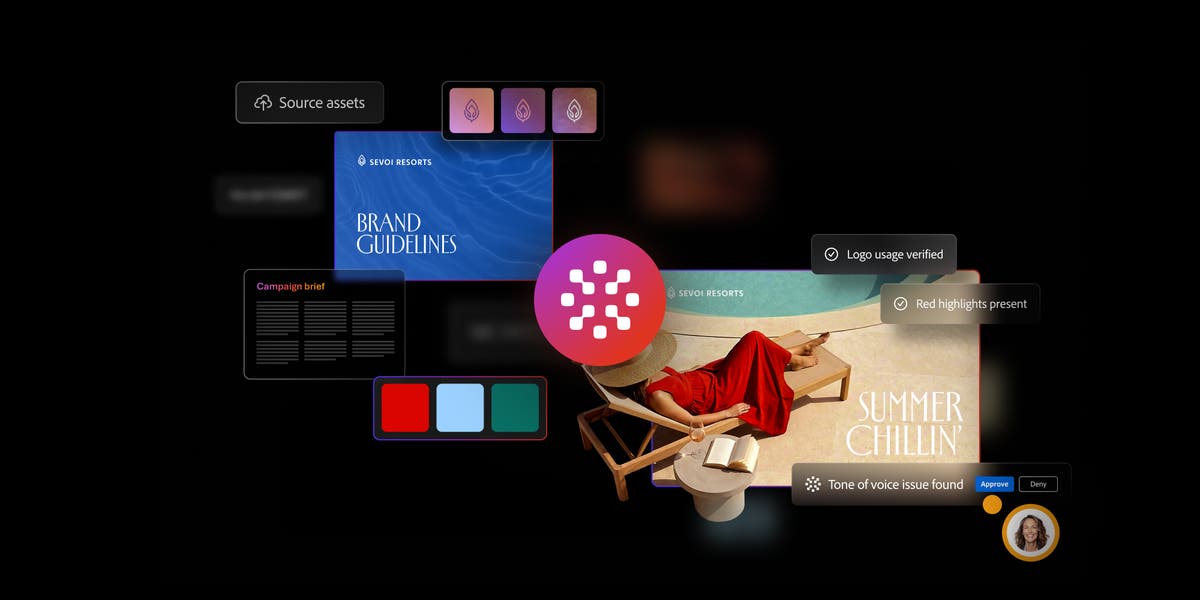
Adobe Brand Intelligence Reviews Creative Against Guidelines Written for People
AdobeNovember 10, 2026Adobe Brand Intelligence checks content against a brand's existing guidelines without turning them into rigid rules. Proprietary vision models check typefaces, logo variants, colors and clear space; a reasoning layer applies each guideline in context; and the system learns from reviewers' approvals and corrections, with brand experts deciding what it keeps.
Read the full postWhy it matters: As AI multiplies content, brand review becomes the bottleneck. What stands out is that it learns from reviewers' decisions rather than a fixed checklist, so it can tell a deliberate creative choice from a real mistake.
Tools News
Screaming Frog 25 Lets AI Assistants Set Up Crawls via MCP
Version 25.0 switches configuration files to JSON. An AI assistant connected through the MCP can now set up a crawl from a plain-English request, from JavaScript rendering to custom extraction, and explain why a crawl failed. The release also adds custom dashboards, configurable issues, automatic throttling when a server pushes back, a Social tab for Open Graph tags and page export to Markdown.
Why it matters: Mastering Screaming Frog has long been complex: since the MCP integration, the barrier to entry keeps getting lower, and that's a good thing. You describe the crawl you want in plain language from Claude Code, and the AI handles the configuration, down to the XPath for custom extraction.
Free Sentiment Model That Scores a Page's Sentences
Dan Petrovic (DEJAN)November 2, 2026DEJAN released a free sentiment model on Hugging Face that scores each heading, list item and sentence on seven levels, from very negative to very positive, and runs on a laptop. It gets 84% of labels exactly right on its test set, but works in English only and was trained on AI-written text.
Read the full postWhy it matters: A new tool from Dan Petrovic. Being cited isn't enough: if the fact is wrong or the tone negative, the mention doesn't help and calls for different actions. That's why we track both sentiment and the claims AI makes about a brand at scale with Adobe Brand Visibility; this model goes down to the sentence, to pinpoint what's negative in an AI answer or in the pages it cites. It can also help categorize customer reviews, a use I hadn't thought of.
Free Claude Skill That Rewrites Pages to Get Cited by AI
Chris Long (Nectiv)November 2, 2026Chris Long released a free, open-source Claude Code skill that audits an existing page and suggests changes backed by citation studies from Kevin Indig, AirOps, Chris Green and Nectiv: key takeaways at the top, specific names and numbers instead of vague phrases, verified statistics, tables, definitive language and Q&A sections. It delivers a Google Doc listing each change, before and after, with the full revised article.
Read the full postWhy it matters: I don't usually like sharing skills, but this one looks solid, and it comes from Chris Long, who has nothing left to prove: each recommendation cites the study behind it, so you can decide what to keep. These are correlations, not proven causes: use it as a checklist on a few pages and test, rather than rewriting the whole site in one go.
Please note: All opinions and blog posts shared on this website are strictly my own personal projects. They do not represent the views, strategies, or official products of my employer, Adobe.

Hi, I'm Quentin, an SEO/GEO Specialist at Adobe building AI powered tools for Site Optimizer and Brand Visibility. I use this site to document my thoughts on where search is heading in the age of AI, and to share the strategies and shortcuts I rely on.
Connect on LinkedInMore News Digests
SEO, GEO & AI News: October 19th – November 1st, 2026
Stay ahead with the latest SEO & GEO news (October 19th – November 1st, 2026). Insights on poisoned SERPs, Exa, personal AI agents and ads in AI Mode.
SEO, GEO & AI News: October 5th – October 18th, 2026
Stay ahead with the latest SEO & GEO news (October 5th – October 18th, 2026). Insights on AI agents and WebMCP, the ChatGPT UTM bug and Claude's new rules.
SEO, GEO & AI News: June 8th – June 21st, 2026
Stay ahead with the latest SEO & GEO news (June 8th – June 21st, 2026). Insights on Google's May core update, llms.txt reality, and Adobe Brand Visibility.
SEO, GEO & AI News: May 25th – June 7th, 2026
Stay ahead with the latest SEO & GEO news (May 25th – June 7th, 2026). Insights on Google's May core update, the llms.txt debate, and Adobe's Semrush deal.
SEO, GEO & AI News: April 13th – April 26th, 2026
Stay ahead with the latest SEO & GEO news (April 13th – April 26th, 2026). Insights on OpenAI’s crawling surge, Gemini's market share, and agentic commerce.